The Professional Difference · Florida
What Pressure Washer Do You Need for Pavers? GPM vs. PSI
For cleaning pavers, water flow (GPM) matters more than pressure (PSI). Pressure breaks grime loose, but flow is what rinses it away — and on large surfaces, high flow with a surface cleaner cleans better and faster without damage. We run a 5.5 GPM rig with a surface cleaner; a typical rental moves only 1.5–2.5 GPM. Cranking PSI on a low-flow washer to compensate scars pavers and blasts the joint sand out.
Walk into any rental counter and you’ll be sold on PSI — the bigger the number, the better, right? For pavers, that’s backwards. The spec that actually determines how well and how safely your pavers get clean is the one nobody advertises: gallons per minute.
PSI vs. GPM, in plain terms
PSI (pounds per square inch) is the force of the water — it knocks dirt loose. GPM (gallons per minute) is the flow — the volume of water carrying that dirt away. Think of it like a broom versus a hose: PSI sweeps the grime free, GPM washes it off. On a small greasy spot, force helps. On a whole patio or driveway, it’s the flow doing the real work.
Why GPM wins on big surfaces
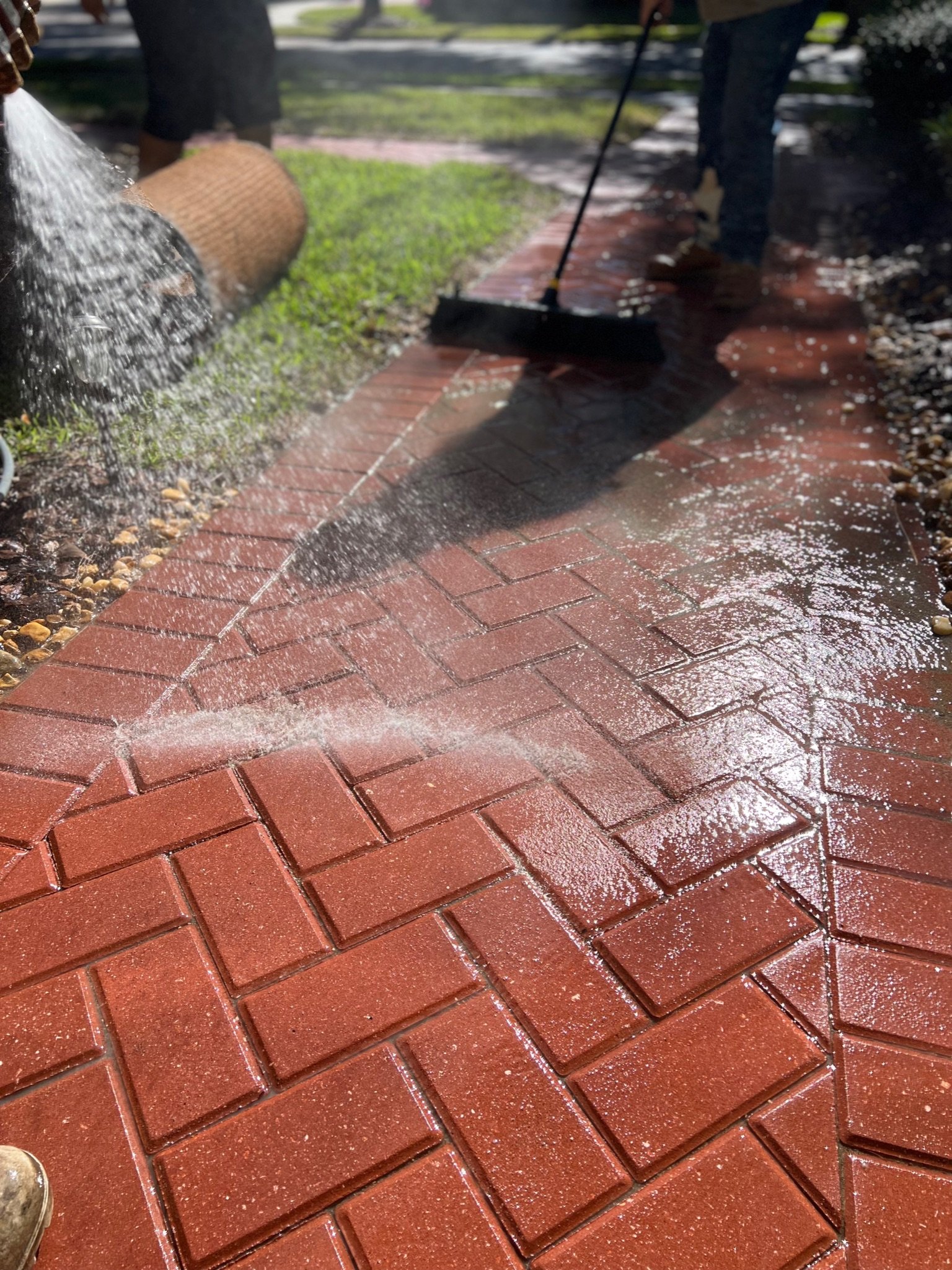
A driveway or pool deck is a lot of square footage. Low flow means you’re rinsing a little at a time, dragging the job out and leaving behind a filmy residue as dirty water re-settles. High flow floods the surface and carries the grime off in one pass. Paired with a surface cleaner — a spinning bar that spreads the water evenly under a hood — good GPM gets pavers uniformly clean without the zebra-stripe marks a hand wand leaves.
The rental trap
Most rental and box-store washers are built around PSI, not flow — often 1.5–2.5 GPM. When it won’t clean fast enough, the natural move is to switch to a narrow, high-PSI nozzle and get in close. That’s exactly what damages pavers: the concentrated jet etches the paver face and blasts the joint sand out, turning a cleaning job into a re-sanding job. The low-flow machine created the problem the high-PSI nozzle then makes worse.
“PSI is the pitch; GPM is the clean. On a driveway, flow is what actually rinses the dirt away.”
What the pros run
Kingdom Elite cleans with a 5.5 GPM rig and a surface cleaner. The high flow rinses thoroughly, the surface cleaner keeps the pressure even and off the paver faces, and the whole surface comes clean at a lower, safer pressure than a homeowner would ever dial in with a wand. Clean, even, and no blown-out joints — which is the foundation a good seal is built on.
If you’re going to DIY it
Skip the highest-PSI nozzle. Use the widest fan tip that still cleans, keep the wand moving and back from the surface, and — most importantly — add a surface cleaner attachment if your machine has the flow to run one. Just know that most rental units simply don’t move enough water to clean a large surface the way a professional rig does.
How many GPM do I need to clean pavers?
More is better for rinsing — pros run about 4 to 5.5 GPM with a surface cleaner. Most rentals only move 1.5–2.5 GPM, so they clean large surfaces slowly and unevenly.
Will a pressure washer damage pavers?
It can — a narrow high-PSI nozzle up close scars the paver face and blasts out joint sand. A surface cleaner with good flow cleans evenly at safer pressure.
Is PSI or GPM more important for cleaning pavers?
On big flat surfaces, GPM. PSI loosens grime; GPM rinses it away. High pressure with low flow tends to stripe and gouge.
Sources: CMHA Tech Note PAV-TEC-005 (cleaning, sealing & joint-sand stabilization); CMHA Tech Note PAV-TEC-006 (operation & maintenance).
Want it done right the first time? Kingdom Elite Services cleans and restores pavers across Tampa Bay — see paver cleaning & pressure washing in Tampa Bay.
Want it cleaned right, without the damage? Get a free on-site estimate →