Florida-Specific · Travertine
Do You Need to Seal a Travertine Pool Deck in Florida?
Yes — most travertine pool decks in Florida should be sealed, with a breathable penetrating sealer, not a glossy film. The exceptions matter: brand-new stone that is still shedding efflorescence, and stone sealed recently that still repels water, should not be sealed yet. Below is how to tell which one you have.
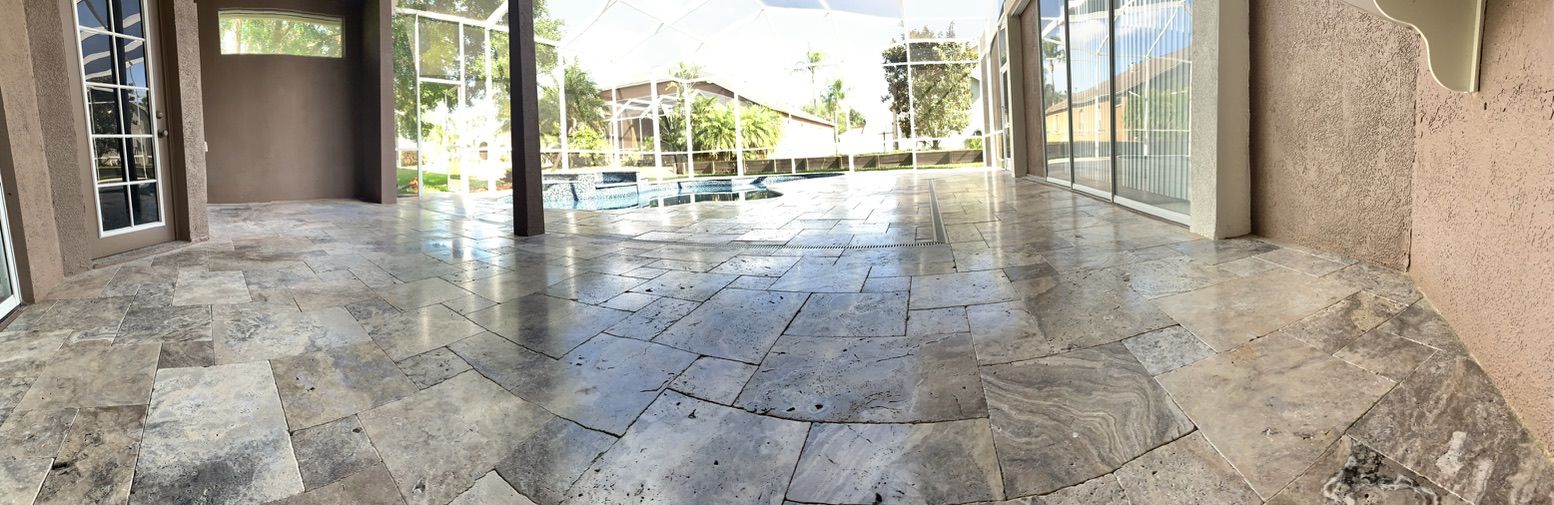
If you just bought a house with a travertine pool deck, or had one installed, nobody probably told you it needs maintenance. That is the most common thing we hear on estimates in Tampa Bay: “I thought it was stone — I thought it was done.” Travertine is stone, but it is a soft, porous, calcium-based stone, and a Florida pool deck is about the hardest place you can put it. This guide answers the question the way we answer it in a driveway conversation: honestly, including the cases where the right answer is “not yet.”
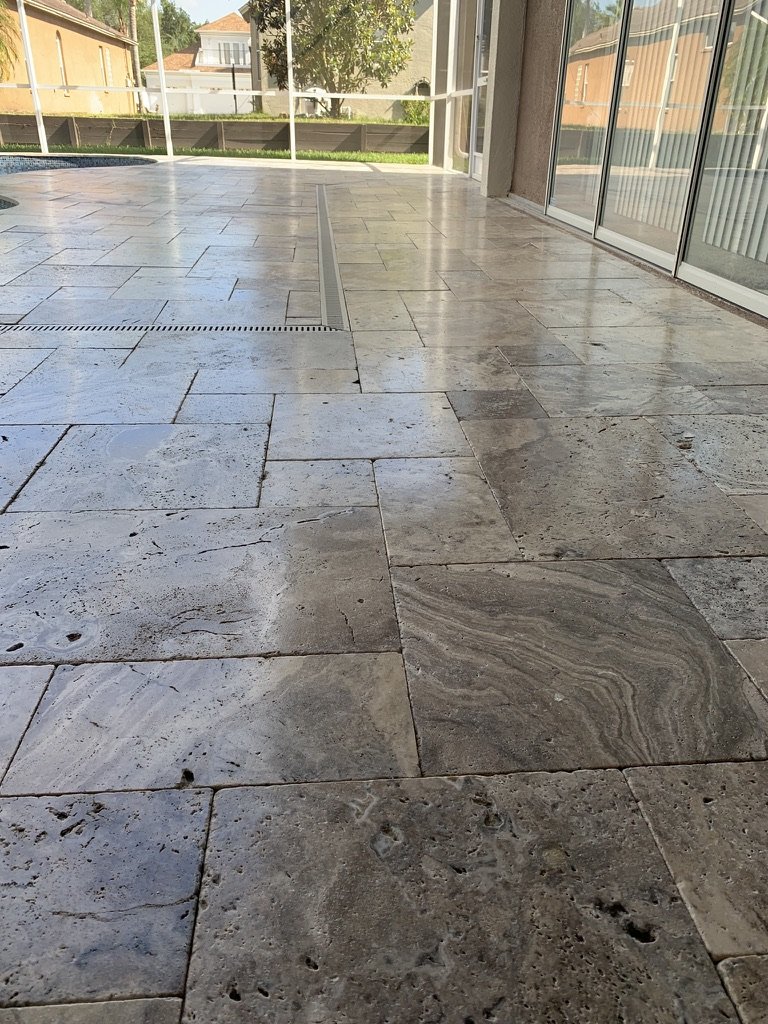
The short answer, and why it isn’t “always”
Unsealed travertine drinks. Pool water, sunscreen, oak tannin, rust from patio furniture and mildew in the pits all soak in and stay. A penetrating sealer takes up that space first, so stains sit on top where they can be cleaned off, and salt and chlorine can’t work into the stone as freely. It does not change the color, texture, temperature or grip of the stone — provided it is a penetrating product and not a film.
But sealer is a treatment, not paint. Sealing stone that is still pushing out efflorescence, or stone that is already sealed, wastes money at best and causes problems at worst. So the honest answer is: yes for most decks, once the stone is ready, and only when a simple water test says it is due.
Why Florida is different
Salt and chlorine, constantly. Salt pools are now common on new builds in Tampa Bay. Salt water splashed on porous stone dries and leaves crystals in the pores; over seasons that can pit and spall the surface of soft stone. Chlorine pools bleach and dry the stone. Either way, the deck is wet with treated water most of the year.
UV. Our sun is relentless from April to October. UV doesn’t hurt travertine itself much, but it breaks down film-forming sealers fast — one reason glossy coatings on Florida stone turn cloudy, peel or get slick.
Wet-season humidity and daily rain. From June to September the stone rarely dries out. Mildew and algae take hold in the natural pits and in the joint sand, especially on shaded lanais.
Efflorescence on new stone. New travertine and the setting bed under it carry mineral salts that migrate to the surface as a white haze. This is normal, not a defect, and it is the biggest reason not to seal a brand-new deck on day one.
When NOT to seal (or not yet)
New travertine that is still shedding efflorescence. If a white, powdery haze keeps coming back after you rinse the deck, the stone is still pushing out salts. Sealing over it traps the haze or lets the salts push the sealer off. There is no fixed number of weeks — it depends on the stone, the setting bed and the weather. The rule: seal after the efflorescence has run its course or been treated with an acid-free remover, not before.
Stone that was sealed recently and still works. Flick water on a dry patch. If it beads or sits on top for a minute or more before soaking in, the sealer is still doing its job. Leave it alone.
Polished or honed interior travertine. Indoor polished floors and vanities are a different job with different products; this outdoor pool-deck guidance doesn’t apply. (We don’t hone or polish stone.)
Stone with a moisture or drainage problem, or loose and sunken pieces. Sealing locks a wet problem in, and sealer does not glue stone down. Fix drainage and reset pieces first; seal after. More on this in when you should not seal.
Sealed vs. unsealed after a Florida year
Picture two identical travertine pool decks installed the same week. A year later, the unsealed deck has a faint tide line where pool water dries, a green-black cast in the pits on the shaded side, and a couple of rust spots where chairs sat. Nothing is ruined, but the mildew now needs a stone-safe soft wash, not pressure. The sealed deck (breathable penetrating sealer, applied after the efflorescence cleared) looks like the stone — no shine, no color change — and rinses clean, with the same barefoot grip as the day it went in. At one year the difference is modest. At three years it isn’t.
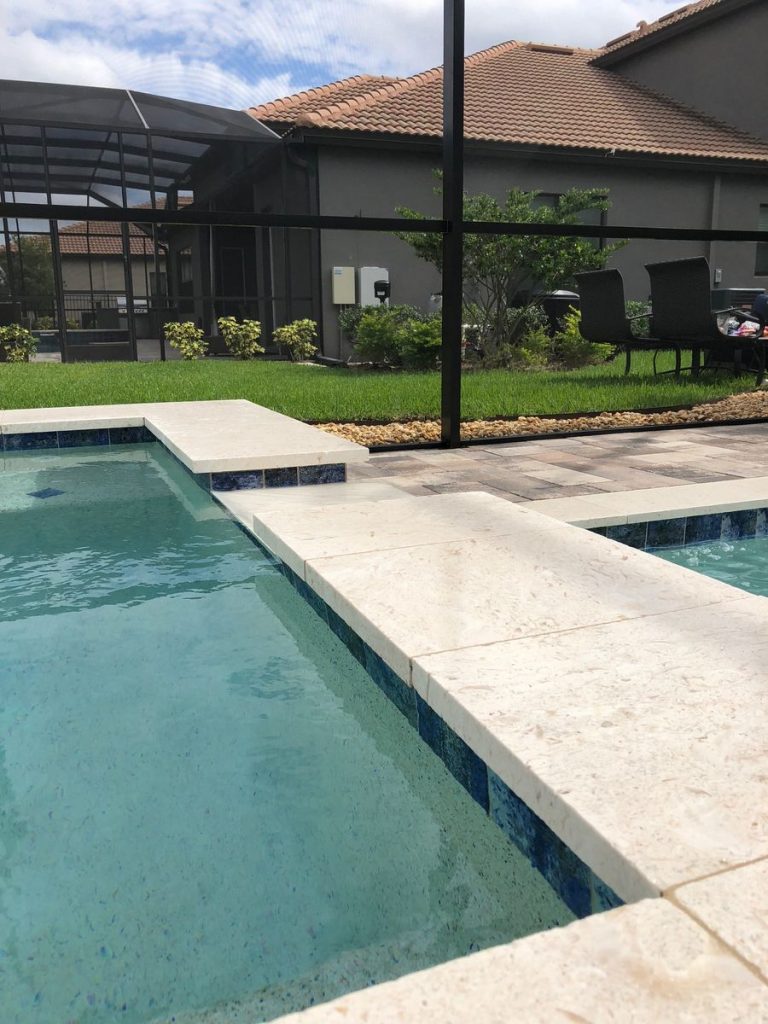
Best sealer for a travertine pool deck: penetrating vs. film
Penetrating (impregnating) sealers soak in and cure below the surface. They are invisible, breathable — moisture vapor can still leave the stone — and they don’t change traction. On new or never-sealed natural stone we use a water-based penetrating sealer (ICT Stone Show H₂O Invisible).
Film-forming (topical) sealers — the acrylics and urethanes that give brick pavers the “wet look” — sit on top as a coating. On bare travertine they can look plastic, get slick when wet, and haze or peel.
The exception is a deck that has already been film-sealed. You can’t put a penetrating sealer over a film. The two honest options: reseal with the same product (Ure-Seal H2O Gloss) plus an anti-slip additive so it keeps its look but stops being slippery, or strip the old coating completely and convert to a penetrating sealer. Stripping takes up to 2 days depending on condition and adds a per-square-foot charge, but it is a one-time cost. Whatever the product: never clean travertine with muriatic or any strong acid — it etches the stone permanently.
How often does travertine have to be sealed in Florida?
Plan on resealing a Florida travertine pool deck about every 18–24 months. That is sooner than the 2–3 years a film sealer lasts on brick pavers: pool water, chlorine or salt, sun and bare feet wear a penetrating sealer from the top of a porous stone.
Use the water test to fine-tune it. On a dry morning, splash water on a high-traffic spot and near the pool edge. If it darkens the stone and soaks in within a few seconds, the sealer is gone there and it is time. If it sits, you have time. Between sealings, a gentle stone-safe soft wash clears mildew — never high pressure, never acid.
What it costs to seal a travertine pool deck (2026)
| Job | Standard 2026 rate |
|---|---|
| Clean & seal travertine | $1.50 – $1.75 / sq ft |
| Clean & seal marble, limestone, flagstone | $1.40 – $1.50 / sq ft |
| Strip a failed film sealer first | + $1.25 / sq ft |
| Typical pool deck / lanai, 800–1,200 sq ft | about $1,200 – $2,100 |
Those are Kingdom Elite’s own standard rates, from more than 1,500 jobs since 2016 across Tampa Bay and the Nature Coast — the same figures published in our 2026 Florida Paver Sealing Cost Index. Final price is confirmed after an on-site look, because the condition of the stone and the joints is what moves it.
What the installer or pool builder won’t tell you
The white haze is normal, and it means “wait.” Efflorescence on new travertine is not a defect, but the deck isn’t ready to seal yet. “It’s natural stone, it doesn’t need anything” is half true. It doesn’t need a coating; it does need its pores protected. The joint sand matters as much as the stone. Low or washed-out joints let water under the deck and grow weeds and mildew.
What we do on a visit
We look first. On a free estimate for a travertine pool deck we identify the stone and whether anything has ever been put on it, check for active efflorescence, do the water test in a few places, look at the joints and any loose or sunken pieces, and then tell you one of three things: it’s ready and here is the written price; it needs a repair or a strip first and here is what that adds; or it doesn’t need sealing yet. The third answer is not rare.
Frequently asked questions
Does a travertine pool deck need to be sealed in Florida?
Yes, for most decks. Salt or chlorine pool water, UV and wet-season mildew all work into unsealed, porous travertine. Use a breathable penetrating sealer — but wait until new stone has stopped shedding efflorescence, and skip it if a recent seal still repels water.
How often should travertine be sealed in Florida?
About every 18–24 months for a pool deck — sooner than brick pavers. Confirm with the water test: if water soaks into a dry spot within seconds, it’s time.
What is the best sealer for a travertine pool deck?
A water-based, breathable penetrating (impregnating) sealer. It is invisible, doesn’t change traction, and lets moisture escape. Film-forming gloss sealers get slippery when wet and can haze or peel on porous stone.
Should I seal new travertine right away?
No. New travertine and its setting bed push mineral salts to the surface as a white haze (efflorescence). Seal once that has run its course or been removed with an acid-free product — there is no fixed waiting period.
What does it cost to seal a travertine pool deck?
Around $1.50–$1.75 per square foot for a clean and seal in Tampa Bay in 2026, so a typical 800–1,200 sq ft pool deck runs roughly $1,200–$2,100. Stripping an old failed coating adds about $1.25 per sq ft. Final price follows an on-site look.
My travertine is already slippery and shiny — can that be fixed?
Yes. It was film-sealed. Either reseal with the same product plus an anti-slip additive, or strip the coating and convert to a penetrating sealer for a natural, non-slip finish.
Sources: ICT Stone Show H₂O Invisible product data (penetrating sealer); ICT Ure-Seal H2O product data; CMHA Tech Note PAV-TEC-005; Kingdom Elite Services 2026 standard rates (Cost Index).
Not sure your travertine needs it yet? Get a free estimate from Kingdom Elite Services — we’ll tell you if you can wait.
See Travertine Sealing in Tampa Bay →Or call or text (813) 421-3109