Durability · Florida · Edition No. 01
How Long Does Paver Sealing Last in Florida?
Short answer: In Florida, a professionally applied paver sealer typically lasts 2 to 3 years — closer to 2 on a driveway baking in full sun, closer to 3 (or a little longer) on a shaded, covered patio. Florida’s near-tropical UV, 70–90% humidity, and a June-through-September rainy season break sealer down faster than almost anywhere else in the country. A proper two-coat application over a clean, re-sanded surface is what gets you to the long end of that range.
Sealer is a sacrificial layer — it takes the abuse so your pavers don’t. In Florida, that abuse is relentless, and knowing what wears a coating out is the key to knowing when your surface is due for a refresh.
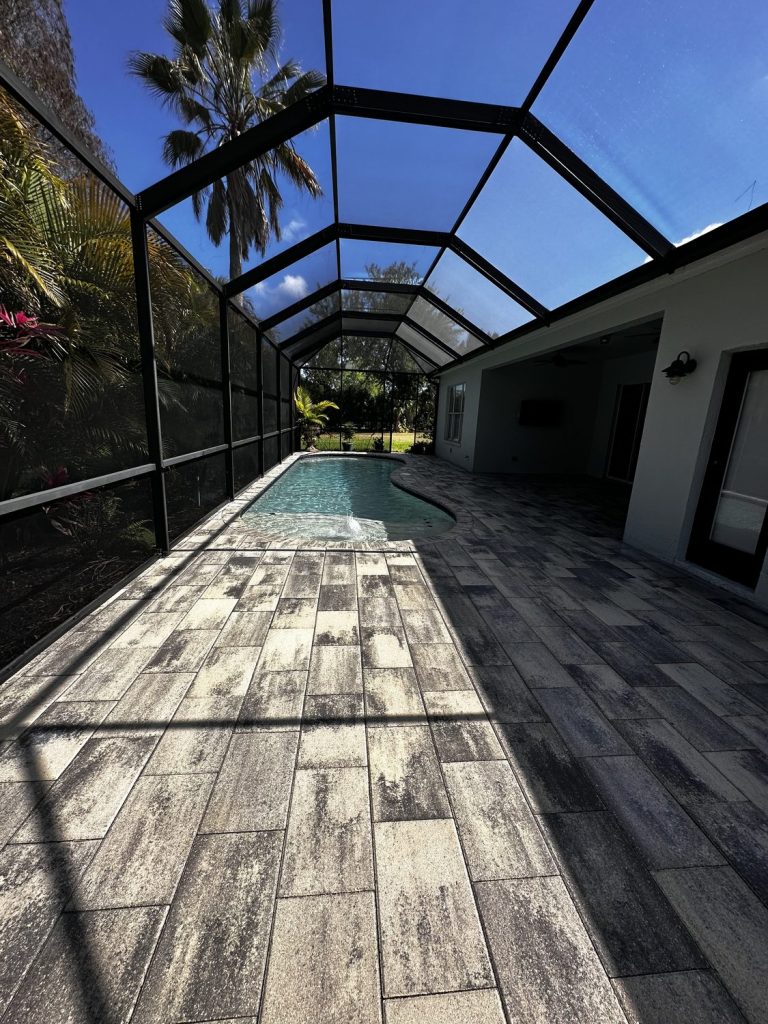
Why does sealer wear out faster in Florida?
- UV. Tampa Bay’s summer UV index regularly hits 10–11 (“very high” to “extreme”). UV is the single biggest destroyer of sealers: it breaks down the resins that hold the coating together, which is why color fade and chalking show up first on the sunniest sections.
- Rain. The Tampa area averages roughly 45–50 inches of rain a year, most of it in the June–September rainy season — often hard, daily afternoon thunderstorms. Every downpour works at the sealer’s surface and flushes joint sand.
- Humidity and biology. Relative humidity in west-central Florida runs high year-round. Warm plus wet means mold, mildew, and algae colonize any surface the moment its protection thins — you often see the sealer failing before you can measure it.
- Sprinklers and shade lines. Irrigation overspray keeps some zones permanently damp, and hard well water leaves mineral deposits. The parts a sprinkler hits every morning age differently than the parts it misses.
The result: a sealer that might coast 3–5 years in a dry climate needs attention on a 2–3 year cycle here.
How long does sealer last on each surface?
| Surface | Typical Florida exposure | Where it lands in the 2–3 yr cycle |
|---|---|---|
| Driveway | Full sun, vehicle traffic, tire scuffing, oil drips | Earlier — plan on the 2-year end |
| Pool deck | Sun plus constant water, chlorine/salt splash, bare feet | Middle of the range |
| Uncovered patio / walkway | Sun and rain, foot traffic only | Middle of the range |
| Screened or shaded patio (lanai) | Filtered sun, less rain contact | Later — the 3-year end, sometimes longer |
“A north-facing covered lanai and a west-facing driveway on the same house are living two different lives.”
What are the signs your paver sealer is wearing off?
- Water stops beading. When rain soaks straight in and the pavers darken like a sponge, the sealer is gone or nearly gone.
- Color goes flat. Fading back to a dry, chalky gray is UV telling you the coating has broken down.
- Mold and algae return. Green film in shady spots and black streaks after the rainy season mean the surface is absorbing moisture again.
- Joint sand washing out. Sand splashing out during storms — followed by weeds and ants — is a late-stage sign.
- White haze or efflorescence. Whitish blooming can mean moisture is moving through the pavers unchecked, or an old sealer coat is failing.
If you’re seeing two or more of these, you’re past due — and every month of delay lets stains and organics penetrate deeper into unprotected pavers.
Does the type of sealer change how long it lasts?
Yes — both the product and how it’s applied. Kingdom Elite seals with Ure-Seal H2O, a professional water-based sealer, applied in two coats: a flood coat that saturates the surface and joints, then a top coat that builds the wear layer. Two properly timed coats over a clean surface outlast a single thin coat every time — a lot of short-lived seal jobs are really application failures, not product failures. Curing matters too: the sealer is rain-safe about 2 hours after application, ready for foot traffic about 4–6 hours after sealing, but keep vehicles off for 48–72 hours so the coating can fully harden.
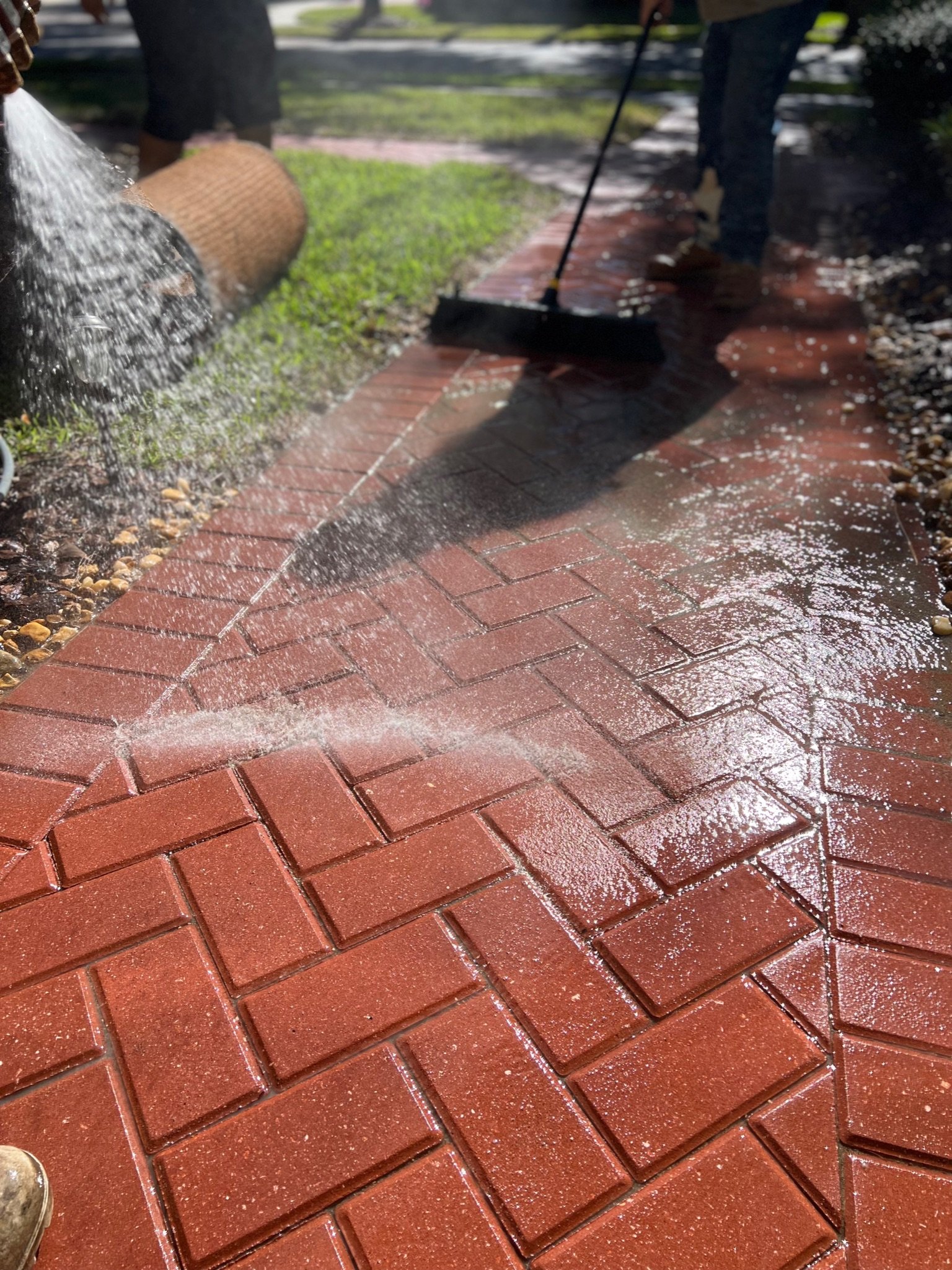
Just as important is what happens before the sealer goes down. Sealing over dirt, algae, or failing old sealer locks the problem in. That’s why every job runs a 4-step process — pressure wash, treat organics and any staining, re-sand the joints, then seal. The prep is most of the lifespan. The finish depends on the surface: pavers get a wet-look gloss (Ure-Seal H2O Gloss); newly installed natural stone like travertine gets a penetrating sealer instead. An anti-slip additive is available for pool decks and walkways.
How do you make paver sealing last longer?
- Soft wash every 6 months. A gentle wash knocks down the dirt and organic growth that eat at the sealer’s surface.
- Keep it clear. Blow off leaves and clippings — decomposing organics hold moisture and feed algae.
- Fix sprinkler overspray. Redirect heads that soak your pavers daily; constant irrigation ages sealer faster than rain.
- Clean spills promptly. Sealer buys time against oil, rust, and tannin stains — it doesn’t make the surface stain-proof forever.
- Skip aggressive DIY pressure washing. High pressure at close range strips sealer and blasts out joint sand.
Is there a warranty on paver sealing?
There’s an important distinction between normal wear and product failure. Sun gradually dulling a finish over a few years is normal wear — that’s the reseal cycle. Sealer cracking, peeling, or discoloring prematurely is a material-failure defect, and that’s what a warranty covers. Kingdom Elite backs its work with a 3-year limited warranty using Ure-Seal products, covering material-failure defects like cracking, peeling, and discoloration — plus a 100% Satisfaction Guarantee.
What happens if you wait too long to reseal?
Resealing on schedule is a maintenance job. Waiting 5+ years usually turns it into a restoration job: deep-set stains, entrenched mold, washed-out joints full of weeds, faded color that a fresh coat alone can’t bring back — and a failed old coat may need to be stripped first. All of that costs more than staying on the 2–3 year cycle. (See our guide: How much does paver sealing cost in Florida?)
Why it holds up: Kingdom Elite uses ICT Ure-Seal H2O, a professional non-yellowing water-based urethane that showed no color or gloss change after 2,500 hours of accelerated UV testing (ASTM QUV) — which is why a properly applied seal keeps its look through Florida sun. Source: ICT (Innovative Concrete Technology) product data.
Frequently asked questions
How long does paver sealing last in Florida?
Typically 2–3 years. Full-sun driveways trend toward 2 years; shaded or covered patios can stretch to 3 or a bit beyond. Florida’s UV, humidity, and summer rainy season wear sealer faster than drier climates.
How often should you reseal pavers in Florida?
Most Tampa Bay homeowners reseal every 2–3 years — sooner for high-sun driveways, longer for shaded patios. Full details in our companion guide: How often should you reseal pavers in Florida?
How can I tell if my pavers need resealing?
Water soaking in instead of beading, faded or chalky color, returning mold and algae, joint sand washing out, or white haze — two or more of these means it’s time.
Does a two-coat application really last longer?
Yes. A flood coat that saturates the surface plus a separate top coat builds a thicker, more durable wear layer than one thin coat — Kingdom Elite applies Ure-Seal H2O this way on every job.
How do I make my sealed pavers last longer?
Soft wash every 6 months, keep debris off the surface, redirect sprinkler overspray, and clean spills promptly. Good maintenance gets you to the long end of the 2–3 year cycle.
How long after sealing before you can walk or drive on the pavers?
The sealer is rain-safe about 2 hours after application. Foot traffic is fine about 4–6 hours after sealing. Keep vehicles off for 48–72 hours so the sealer can fully cure.
Sources: ICT Ure-Seal H2O product data (Innovative Concrete Technologies); CMHA Tech Note PAV-TEC-006 (operation & maintenance).
Want it done right the first time? Kingdom Elite Services cleans, re-sands and seals pavers across Tampa Bay — see paver sealing in Tampa Bay.